

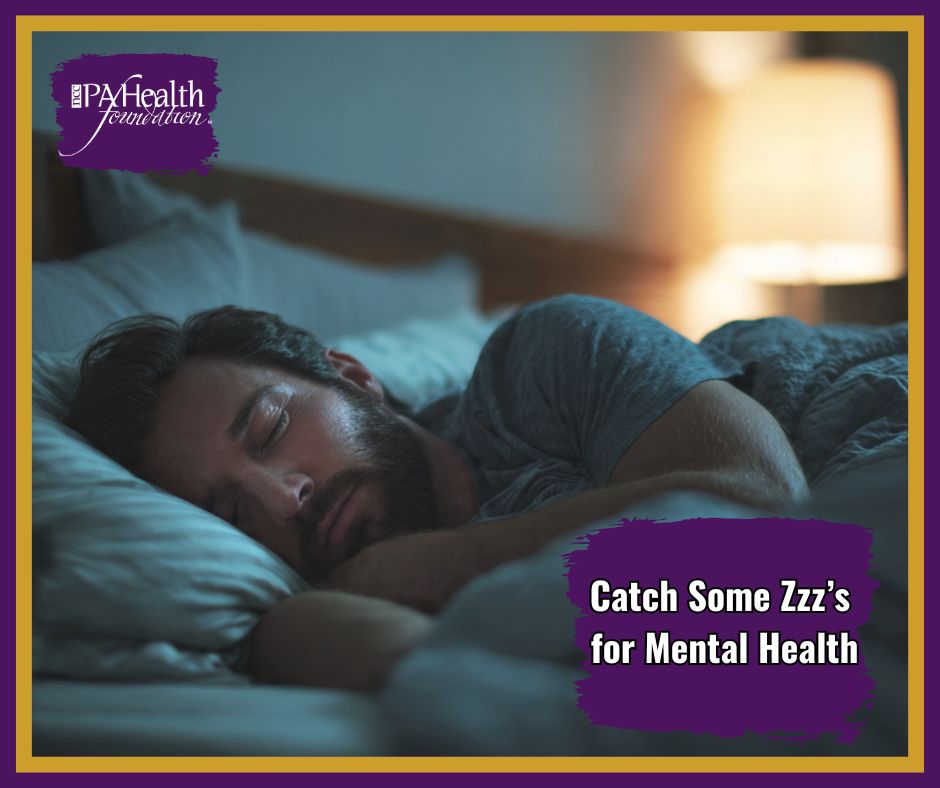
Catch Some Zzz’s for Mental Health
“Mental health begins with rest. You cannot pour from an empty cup.”
— Unknown
In a culture that often celebrates productivity over rest, sleep is frequently treated as optional. Yet, research finds that sleep is not a luxury but a cornerstone of mental and emotional well-being.1,2
Getting enough sleep helps us feel alert, balanced, and resilient. It allows the brain and body to carry out vital restorative processes, from repairing cells to consolidating memories. While the exact amount of sleep needed varies from person to person, most people thrive within age-based ranges that support both physical health and mental clarity.2,3 Consistently falling short can take a toll on physical and mental health and has been linked to weight gain, reduced immunity, high blood pressure, and, depression.1,5
The connection between sleep and mental health is bidirectional. Poor sleep can worsen mood, increase irritability, and make everyday stressors feel overwhelming.2 Even a few nights of disrupted sleep can lead to heightened anxiety and difficulty concentrating.3 Chronic sleep deprivation is associated with higher levels of depressive symptoms: A recent Sleep in America® poll showed that nearly 70% of people who are dissatisfied with their sleep report mild or greater depressive symptoms. In contrast, over 90% of adults with very good sleep health reported no significant depressive symptoms at all.1 Sleep not only affects how we feel, it shapes how we think. When we sleep well, our brains are better equipped to process information, make decisions, and regulate emotions. Without adequate rest, negative experiences tend to loom larger, while positive moments are easier to overlook.2,3
For PAs and all healthcare providers, adequate sleep is critical for patient safety and quality of care. Sleep deprivation impairs attention, reaction time, decision‑making, and emotional regulation, skills that are essential in clinical settings where errors can have serious consequences.3,6 Research has shown that clinicians working extended or overnight shifts experience significantly higher rates of medical errors, near‑miss incidents, and occupational injuries compared to well‑rested providers.7 Fatigued healthcare workers are also at greater risk for burnout, needlestick injuries, motor vehicle accidents after shifts, and impaired communication with patients and colleagues.8 Prioritizing healthy sleep for healthcare professionals is therefore a patient safety imperative, as well as a matter of personal wellness.
One of the most overlooked factors influencing sleep is light exposure. Our circadian rhythm is highly sensitive to light. Bright, natural light during the day helps us feel awake and alert, while dim light at night signals the brain to produce melatonin, the hormone that promotes sleep.2 Yet nearly half of Americans report minimal exposure to bright light during the day, while most use screens right up until bedtime. This combination disrupts the sleep-wake cycle, making it harder to fall asleep and stay asleep.1 Experts recommend spending at least an hour a day in bright light, ideally outdoors, and dimming lights in the evening. Turning off screens at least one hour before bed can significantly improve sleep quality.1
Building healthy sleep habits does not require perfection, just consistency. For patients struggling to regulate their sleep encourage a regular bedtime, a calming wind-down routine, limiting caffeine and alcohol before sleep, and creating a cool, dark, and quiet sleep environment.1
Prioritizing sleep is about living better. When we improve our sleep, we improve how we think and feel as well as how we cope, connect, and thrive.1,3 With rising stress and mental health challenges, sleep awareness may be one of the most powerful and accessible tools that clinicians have. If sleep struggles or mood changes persist, seeking guidance is an important next step. Rest, after all, is foundational to mental health and overall well-being.
References & Resources
- National Sleep Foundation. (2023). Sleep in America® Poll: Sleep and mental health. https://www.thensf.org/sleep-in-america/
- Harvard Medical School. “Sleep and Mental Health.” Harvard Health Publishing, 2022, www.health.harvard.edu/topics/sleep.
- Walker, M. P. (2017). Why we sleep: Unlocking the power of sleep and dreams. Scribner, New York.
- National Sleep Foundation. (2024). Sleep in America® Poll: Teens and sleep. https://www.thensf.org/sleep-in-america/
- American Psychological Association. Sleep and sleep disorders. https://www.apa.org/topics/sleep
- Institute of Medicine. (2009). Resident duty hours: Enhancing sleep, supervision, and safety. National Academies Press. https://doi.org/10.17226/12508
- Lockley, S. W., Cronin, J. W., Evans, E. E., Cade, B. E., Lee, C. J., Landrigan, C. P., … Czeisler, C. A. (2007). Effect of reducing interns’ weekly work hours on sleep and attentional failures. New England Journal of Medicine, 351(18), 1829–1837. https://doi.org/10.1056/NEJMoa041406
- Agency for Healthcare Research and Quality. (2019). The effects of fatigue and sleep deprivation on patient safety. https://www.ahrq.gov